Kck: A Teacher, Healer and Peacemaker
This is Kck — pronounced Kechek.
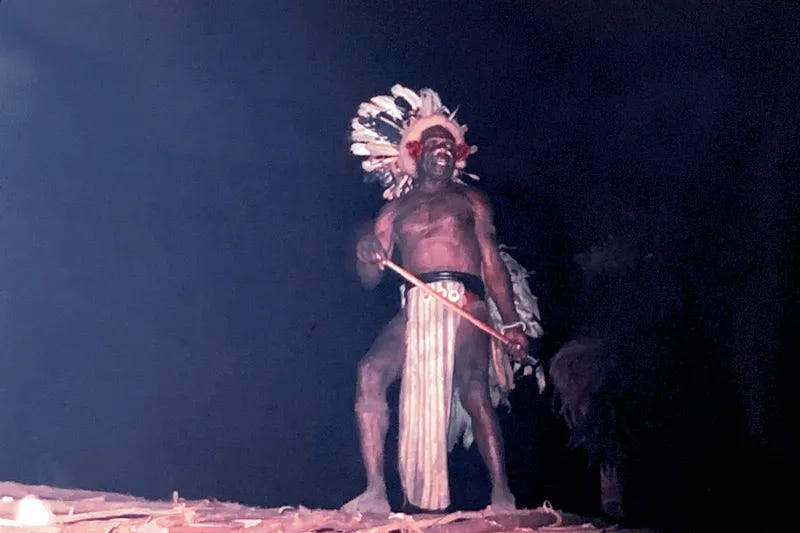
Here he is standing on top of a turtle-roofed long house, speaking at a smy, an annual ceremonial festival that he hosted.
The photograph was taken at night. People had been dancing since late afternoon, and the celebrations would continue until morning. For those gathered, the smy was a time of ceremony, dancing and community — and Kck stood at the centre of it, speaking from above the long house.
But there was much more to Kck than the authority of his position.
A patient teacher
Kck was an amazing man.
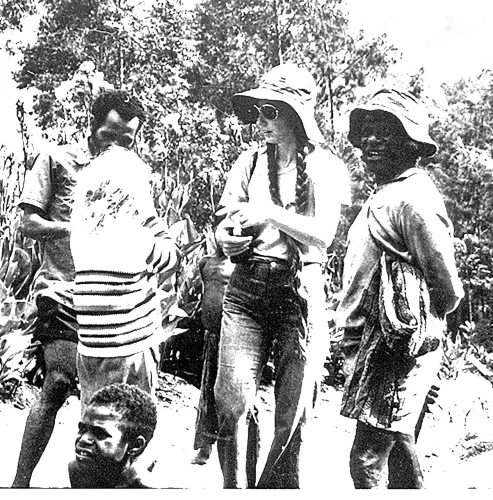
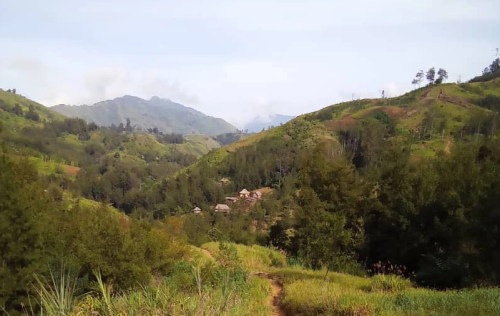
He was extraordinarily patient with me and would take me for long walks through the surrounding country, trying to teach me the names of everything we encountered — the creeks, landforms, birds and other features of the landscape.
He didn't simply give me names. He explained the country and the events that took place within it, helping me understand details and connections that I was otherwise struggling to follow.
Through these walks and conversations, I began to see the landscape through the knowledge of someone who knew it intimately.
Kck was also someone people could turn to when they were unwell.
When I suffered from belly aches, he brought me a special water that he had empowered with kwj, described as an occult power used to modify things.
On another occasion, when I became seriously ill, Kck used a special form of nettle to rub on my belly. The pain had become so severe that I thought I was going to die. Then, just before I reached that point, the pain settled — and I recovered soon afterwards.
For me, these experiences were part of knowing Kck: a man whose knowledge extended across the landscape, the community, ceremony and forms of healing that were unfamiliar to me.
A community in conflict
Kck's influence was not limited to teaching and caring for people. He also played an important role during a much darker period in the community's history.
In 1956, a patrol entered the area attempting to catch fighters involved in a recent battle in which seven people had been killed.
The patrol failed to capture the fighters.
But in the process, the police and carriers accompanying the Patrol Officer subjected local people to terrible violence. People were raped, tortured and terrified. Houses and pigs were destroyed.
Kck had not been centrally involved in the fighting. Yet as the consequences of the conflict and the patrol's actions continued, he eventually decided that enough was enough.
Bringing the fighting to an end
Kck organised a meeting between the Kiap — the Australian colonial patrol officer — and an old leader who was presented as the leader of the fighting.
He then supported the Kiap in organising what became a 'peace' ceremony involving around 500 men.
There was an extraordinary limitation to this peace ceremony: neither of the key fighters actually attended.
Nevertheless, the gathering provided an opportunity for the Kiap to give instructions that there was to be no further fighting.
The following day, the Kiap left the area, taking the police with him.
The immediate crisis had passed.
Remembering Kck
It is easy to remember someone through a single photograph — a man standing above a crowd, speaking from the roof of a long house during an all-night ceremony.
But Kck's story is much richer than that image.
He was a patient teacher who took the time to walk with me and explain the country around us. He shared his knowledge of birds, creeks and landforms and helped me understand events that I could not otherwise have followed.
He was also a healer, drawing on knowledge and practices that were part of his world.
And when violence threatened his community, he became a peacemaker — helping to bring together people and authorities at a moment when fear, anger and grief could easily have led to further conflict.
Kck's story is therefore not simply about one man at a ceremony. It is about knowledge, care, leadership and the ability of one person to help guide a community through both ordinary life and extraordinary times.
The photograph captures Kck speaking at night, with dancing continuing around him. What it cannot capture is the breadth of the knowledge, patience and responsibility that lay behind the man standing on that roof.
 Story